
How Automatic Sewing Equipment Improves Garment Factory Efficiency

How Garment Factories Can Improve Production Efficiency with Automatic Sewing Equipment
In modern garment manufacturing, factories are facing increasing pressure from labor costs, delivery schedules, quality requirements and small-batch production demands. Traditional sewing production still depends heavily on operator skill, especially in repeated processes such as hemming, collar setting, waistband sewing, buttonholing, pocket attaching, folding and packing.
For garment factories, improving efficiency does not always mean replacing the whole production line at once. A practical way is to identify bottleneck processes and upgrade them step by step with automatic sewing and finishing equipment.
Industry automation suppliers have also identified common factory challenges such as labor shortages, retirement of skilled workers, difficulty transferring expertise, the need for small-lot production of diverse products, quality stabilization and improved plant management.
Why Automation Matters in Garment Production
Garment production is different from many other manufacturing industries. Fabric is soft, flexible and easy to deform, so automation must control feeding, positioning, folding and sewing carefully. Research on apparel automation also points out that garment sewing remains technically challenging because fabric manipulation is complex.
This is why the most practical automation strategy is process-based automation. Instead of asking, “How can we automate the whole factory at once?”, garment factories should ask:
- Which process uses the most labor?
- Which process has unstable quality?
- Which process slows down the production line?
- Which process is repeated every day?
- Which process can be standardized by machine?
For many garment factories, T-shirt bottom hemming and garment folding/packing are two important areas where automation can quickly improve workflow efficiency.
1. Improving T-Shirt Bottom Hemming Efficiency
T-shirt bottom hemming is a high-frequency process in knitwear and casualwear production. In traditional production, operators need to control the fabric edge, folding width, sewing speed and finished hem quality at the same time. When production volume increases, manual hemming can easily become a bottleneck.
For this process, VMA recommends:
V-W500APW-BHR Automatic T-shirt Bottom Hemming Machine
According to the product information provided, the V-W500APW-BHR is designed for adult tubular T-shirt bottom hemming. One operator can operate two machines, and the production capacity can reach 6–8 pieces per minute under suitable production conditions.
Key Advantages
- Suitable for adult tubular T-shirt bottom hemming
- One worker can operate two sets
- Capacity reference: around 360 pieces per hour by two machines with one operator
- Hemming width adjustable from 15–25 mm
- Suitable T-shirt perimeter: maximum 160 cm, minimum 80 cm
- Automatic guide system
- Stackable product collection after trimming
- Suitable for cotton, cotton-polyester, viscose, cotton-spandex and other common T-shirt materials
The value of this machine is not only sewing speed. More importantly, it helps standardize the hemming process, reduce operator workload and keep bottom hem quality more consistent.
2. Improving Folding and Packing Efficiency
After sewing, garment factories still need finishing processes such as inspection, folding, stacking and packing. These steps may look simple, but they require repeated manual operations every day.
For factories producing T-shirts, polo shirts, sweatshirts, pants and thin coats, automatic folding and packing equipment can help improve the final production section.
For this process, VMA recommends:
V-FPS-1 Automatic Clothes Folding & Packing Machine
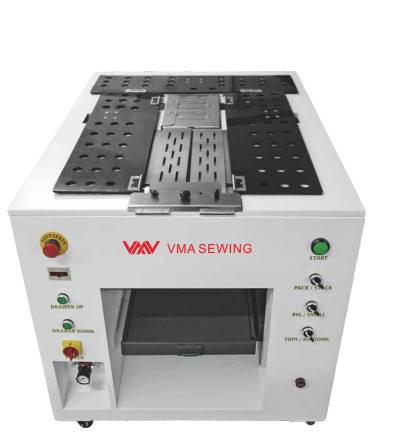
According to the product information provided, the V-FPS-1 is designed for garment folding and packing applications.
Product Specification

Key Advantages
- Small space requirement
- Simple operation
- Standard folding effect
- Two working modes: packing with bag or stacking without bag
- Folding length and width can be adjusted
- Can connect with conveyor transfer equipment for the next working area
For garment factories, finishing efficiency is important because slow folding and packing can delay shipment even when sewing production is completed on time. Automatic folding equipment helps improve workflow after sewing and makes the final packing process more stable.
How Automatic Equipment Improves the Whole Production Line
Automatic sewing and finishing equipment can improve garment factory efficiency in several ways.
1. Reducing Repeated Manual Operations
Processes such as bottom hemming, folding and packing are repeated thousands of times in daily production. Automation helps reduce manual handling and keeps production rhythm more stable.
2. Improving Output per Operator
When one worker can operate multiple machines or manage a semi-automatic process, the factory can improve labor utilization without simply increasing the number of workers.
3. Stabilizing Product Quality
Automatic machines help standardize feeding, folding, trimming and collection. This reduces differences caused by operator skill and fatigue.
4. Reducing Production Bottlenecks
A production line is only as efficient as its slowest process. If bottom hemming or packing is slower than other sections, automatic equipment can help balance the line.
5. Supporting Larger and More Stable Orders
For export garment factories, stable efficiency and quality are important for meeting delivery schedules and buyer requirements.
Recommended Automation Upgrade Strategy
For garment factories that want to improve efficiency, VMA recommends a step-by-step approach:
- Identify the slowest process in the current production line
- Check which process depends most on skilled workers
- Start automation from repeated and standardized operations
- Combine sewing automation with finishing automation
- Track output, labor use and quality improvement after machine installation
For example, a T-shirt factory can first upgrade bottom hemming with the V-W500APW-BHR, then improve finishing and packing with the V-FPS-1. This creates a more complete production improvement from sewing to packing.
Conclusion
Garment automation is not only about using more advanced machines. It is about improving the whole production process.
Automatic sewing and finishing equipment can help garment factories reduce repeated manual work, increase output, stabilize product quality and improve delivery efficiency. For T-shirt and knitwear production, automatic bottom hemming and automatic folding/packing are two practical upgrade points.
With machines such as the V-W500APW-BHR Automatic T-shirt Bottom Hemming Machine and the V-FPS-1 Automatic Clothes Folding & Packing Machine, VMA helps garment factories build more efficient, stable and process-based automation solutions.
FAQ
How can automatic sewing equipment improve garment factory efficiency?
Automatic sewing equipment reduces repeated manual operations, improves sewing consistency and helps factories increase output with more stable production rhythm.
Which process should a garment factory automate first?
Factories should start with bottleneck processes such as bottom hemming, collar setting, waistband sewing, pocket attaching, buttonholing, folding or packing.
Why is automatic T-shirt bottom hemming useful?
It helps reduce manual fabric control, improves bottom hem consistency and increases production efficiency in knitwear and T-shirt production.
Why is automatic folding and packing important?
Folding and packing are repeated finishing processes. Automation helps improve final product consistency and reduces delays after sewing production.
Can VMA provide process-based garment automation solutions?
Yes. VMA provides automatic sewing and finishing equipment for different garment processes, helping factories upgrade production step by step.
Contact VMA
If you are looking for sewing automation machines for polo shirts, T-shirts, knitwear, garment finishing or other apparel production processes, contact VMA to get machine videos, technical specifications and process recommendations.
//www.vmasewing.com/en/contact.html
TAIZHOU VMA SEWING MACHINE CO., LTD
Sewing Automation Solution Expert