
Automatic Belt Loop Machine for Garment Factory Efficiency
How Automatic Belt Loop Machines Improve Efficiency in Garment Manufacturing
Belt loop attaching is an important process in jeans, trousers, uniforms and workwear production. Although a belt loop looks like a small garment component, the production process often includes several repeated steps: cutting the belt loop tape, folding, feeding, positioning and bartacking.
In traditional garment production, these steps usually require multiple operators or separate machines. This increases labor cost, production time and quality variation. As garment factories continue to upgrade toward automation, the automatic belt loop machine has become a practical solution for improving production efficiency and stabilizing belt loop quality.
1. Why Belt Loop Production Needs Automation
Traditional belt loop production is labor-intensive because each loop must be cut, folded, positioned and sewn accurately. If the belt loop is not folded correctly or the bartack position is inconsistent, the finished garment may look uneven or fail quality inspection.
Automatic belt loop machines help factories standardize this process by combining multiple operations into one machine-controlled workflow.
Major industrial sewing machine manufacturers also position automatic belt loop machines as labor-saving equipment. For example, JUKI describes its automatic belt-loop attaching machine as equipment that reduces the time required for the belt-loop attaching process and supports labor saving by eliminating the previous belt-loop cutting process.
2. What Is an Automatic Belt Loop Machine?
An automatic belt loop machine is a specialized sewing machine designed to complete belt loop processing more efficiently. Depending on the machine configuration, it can automatically complete:
- Belt loop cutting
- Belt loop folding
- Belt loop feeding
- Positioning
- Tacking / bartacking
- Sewing pattern control
JUKI’s automatic two-needle belt-loop attaching machine information also shows that this type of machine can use cutting devices and a belt-loop feeding system to supply the next belt loop before sewing starts, helping reduce waiting time in the production cycle.
3. Recommended Machine: VMA V-T254Q-DNB Automatic Double Needle Belt Loop Machine

For garment factories producing trousers, jeans and workwear, VMA recommends:
V-T254Q-DNB Automatic Double Needle Belt Loop Machine
According to the VMA product information, this machine is designed to automate cutting, folding, feeding and tacking in one process. One machine can replace up to 7 operators under suitable production conditions, helping factories reduce manual work and improve production efficiency.
Key Features
- Automatic double needle belt loop machine
- Automatic cutting, folding, feeding and tacking
- One machine can replace up to 7 operators
- Capacity reference: about 31 pcs/minute
- 10 hours can produce about 1800–2000 pairs of pants
- Up to 70% more efficiency than normal process
- Suitable for standard belt loop processing
- Supports different cutting modes, including triangle cutting and flat cutting
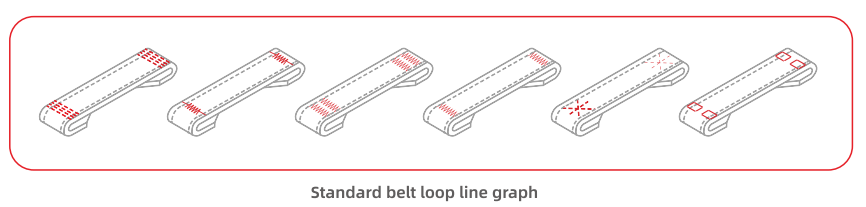
Craft Display


Main Technical Information

For longer belt loop applications, the product information also lists V-T254-DNB-L, suitable for longer belt loops with a length range of 65–85 mm.
4. How It Improves Garment Factory Efficiency
1. Reducing Separate Manual Steps
In a traditional process, belt loop cutting, folding, feeding and tacking may be completed separately. The V-T254Q-DNB combines these steps into one automatic workflow, reducing repeated material handling.
2. Reducing Labor Dependence
Because one machine can complete several process steps, factories can reduce dependence on multiple skilled operators. This is especially useful for large-volume jeans and trousers production.
3. Improving Production Rhythm
Automatic feeding and sewing help keep the production cycle more stable. JUKI’s long belt loop automatic equipment also describes a process where belt loops are automatically fed, cut to a set length and sewn by a two-needle lockstitch machine, showing the industry direction toward integrated belt loop automation.
4. Improving Belt Loop Consistency
Automatic folding and controlled tacking help maintain more consistent belt loop shape, position and sewing quality. This is important for export garment factories where appearance consistency matters across large batches.
5. Supporting Jeans, Trousers and Workwear Production
Belt loops are widely used on jeans, casual pants, workwear and uniforms. For factories producing these garments every day, automating the belt loop process can reduce bottlenecks and improve line balance.
5. Suitable Applications
The V-T254Q-DNB is suitable for:
- Jeans belt loops
- Casual trousers belt loops
- Workwear belt loops
- Uniform pants belt loops
- Medium-to-large garment production lines
- Factories requiring automatic cutting, folding, feeding and tacking
6. Why Automation Matters for Belt Loop Sewing
Garment automation is most effective when applied to repetitive and standardized processes. Belt loop attaching is a typical example because the operation is repeated many times in trousers and jeans production.
Instead of relying only on manual cutting and sewing, an automatic belt loop machine helps factories build a more stable production process. This is especially valuable when factories face labor shortages, rising labor costs or large-volume delivery pressure.
Conclusion
The automatic belt loop machine is an important automation solution for trousers, jeans, uniforms and workwear production. By integrating cutting, folding, feeding and tacking, it helps garment factories reduce manual operations, improve production rhythm and stabilize belt loop quality.
For factories looking to improve efficiency in belt loop production, the VMA V-T254Q-DNB Automatic Double Needle Belt Loop Machine provides a practical solution with automatic processing, double-needle sewing and high production efficiency.
FAQ
What is an automatic belt loop machine?
An automatic belt loop machine is industrial sewing equipment used to automate belt loop cutting, folding, feeding and tacking for trousers, jeans and workwear.
What garments use belt loop machines?
They are commonly used for jeans, trousers, casual pants, uniforms and workwear.
How does an automatic belt loop machine improve efficiency?
It combines several manual steps into one automatic process, reducing labor, saving time and improving production consistency.
What is the recommended VMA model?
VMA recommends the V-T254Q-DNB Automatic Double Needle Belt Loop Machine.
What belt loop size can the V-T254Q-DNB handle?
The standard belt loop length range is 49–75 mm, with belt width 7–20 mm.
Sewing Automation Solution Expert