
How Differential Feed Improves Sewing Quality on Knit and Stretch Fabrics

How Differential Feed Improves Sewing Quality on Knit and Stretch Fabrics
In modern garment manufacturing, knitwear and stretch fabrics are widely used in T-shirts, sportswear, underwear, leggings and other apparel products. While these materials offer flexibility and wearing comfort, their elasticity can create challenges during sewing. Fabric stretching, wavy seams and unwanted puckering are common problems that may affect garment appearance and sewing consistency.
One important technology used to address these challenges is differential feed. Available on many industrial overlock and specialized coverstitch machines, this feeding system helps control fabric movement during sewing. For garment manufacturers, understanding differential feed is essential when selecting an industrial sewing machine for knitwear and stretch fabric production.
1. Why Are Knit and Stretch Fabrics Difficult to Sew?
Unlike stable woven fabrics, knitted fabrics have an interconnected loop structure that allows them to stretch and recover. Their behavior can vary depending on fabric composition, weight, construction and elasticity.
During sewing, the needle, presser foot and feeding mechanism apply pressure and movement to the material. If the fabric is fed unevenly or stretched excessively, several sewing defects may occur:
-
Wavy Seams: Fabric edges stretch during sewing and become rippled after stitching.
-
Fabric Puckering: Uneven feeding creates unwanted gathers along the seam.
-
Uneven Stitching: Different fabric layers may move at different speeds.
-
Seam Distortion: The finished garment may lose its intended shape or appearance.
These problems are particularly relevant to jersey fabrics, rib knits, elastic materials and lightweight stretch textiles.
2. What Is Differential Feed in an Industrial Sewing Machine?
Differential feed is a fabric-feeding mechanism that controls the relative movement of two sets of feed dogs positioned in front of and behind the needle.
Unlike a conventional feeding system where both sets move at a similar rate, differential feed allows their feeding distances to be adjusted independently.
This creates different feeding effects:
-
Equal Feeding: Both feed dogs move at a similar rate, providing normal fabric feeding.
-
Positive Differential Feeding: The front feed dog moves farther than the rear feed dog, feeding more material into the sewing area. This helps control stretching and reduce wavy edges on knit fabrics.
-
Negative Differential Feeding: The front feed dog moves less than the rear feed dog, stretching the material slightly during sewing. This can help reduce puckering on certain lightweight fabrics.
The appropriate differential feed setting depends on the fabric and machine configuration. Manufacturers should always refer to the machine manual and test the material before bulk production.
3. Five Benefits of Differential Feed for Garment Manufacturing
1. Reduces Wavy Seams on Stretch Fabrics
One of the main benefits of differential feed is controlling unwanted fabric stretching.
When sewing T-shirt fabric, jersey or elastic textiles, excessive stretching can cause wavy seam edges. By adjusting the front and rear feeding rates, operators can better control material movement and achieve flatter, more consistent seams.
2. Helps Prevent Fabric Puckering
Lightweight and loosely knitted fabrics can easily develop puckering during sewing.
Differential feed allows operators to adjust how the fabric enters and passes through the sewing area. With suitable settings, unwanted fabric gathering can be reduced, improving the appearance of finished seams.
3. Improves Feeding Consistency
When sewing two layers of stretch fabric together, uneven feeding may cause one layer to move faster than the other.
An adjustable differential feed system helps manage the movement of fabric layers, supporting more consistent seam alignment and sewing results.
4. Supports Different Fabric Applications
Different garment materials require different feeding adjustments. Differential feed provides greater flexibility when switching between fabrics with different stretch and recovery characteristics.
It is particularly useful in:
-
T-shirt manufacturing
-
Sportswear production
-
Underwear manufacturing
-
Leggings and activewear
-
Knitwear and elastic garment production
5. Supports More Consistent Production Quality
By reducing fabric distortion and improving feeding control, differential feed can help minimize certain sewing defects and reduce the need for repeated adjustments or rework.
For garment factories handling large production orders, consistent sewing quality is important for maintaining stable production standards.
4. How to Adjust Differential Feed for Better Sewing Results
Correct adjustment is essential for achieving the expected sewing effect.
Before starting bulk production, manufacturers should consider the following:
-
Identify the fabric type, thickness and stretch characteristics.
-
Begin with the manufacturer's recommended standard feeding setting.
-
Conduct sample sewing and inspect the seam appearance.
-
Adjust the differential feed gradually according to the fabric behavior.
-
Check thread tension, stitch length, needle selection and presser foot pressure.
-
Record suitable settings for repeat production orders.
It is important to understand that differential feed is not the only factor affecting seam quality. Proper machine maintenance, correct needle selection and suitable thread tension are also necessary.
5. VMA Recommended Machine: V-701AT-DF-SS
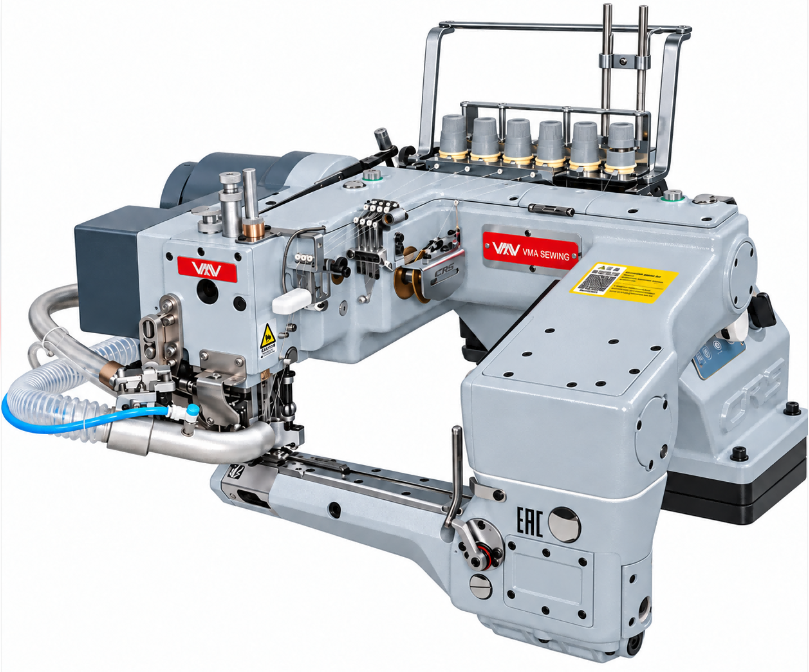
For garment factories working with knitwear and stretch fabrics, VMA recommends the V-701AT-DF-SS High-Speed Direct Drive 4-Needle 6-Thread Coverstitch Machine.
Designed for T-shirts, sportswear, underwear and other stretch garment applications, this model combines adjustable double differential feeding with automatic thread trimming to support efficient sewing operations.
Key Features:
-
Double Differential Feeding: Front and rear differential feed adjustments provide better control over fabric movement.
-
High-Speed Operation: Factory preset speed of 3,200 RPM, with a maximum sewing speed of 3,800 RPM.
-
Automatic Thread Trimming: Helps reduce manual thread-cutting operations.
-
Stable Stitch Formation: Supports neat and consistent stitching on suitable knit and stretch fabrics.
-
Wide Applications: Suitable for T-shirts, knitwear, sportswear, underwear and other stretch materials.
The V-701AT-DF-SS provides a specialized sewing solution for manufacturers seeking better fabric control and consistent stitching in stretch garment production.
Conclusion
Differential feed plays an important role in improving sewing quality on knit and stretch fabrics. By adjusting the relative feeding rates of the front and rear feed dogs, manufacturers can better control fabric movement, reduce wavy seams and minimize unwanted puckering.
For garment factories producing T-shirts, sportswear, underwear and other elastic garments, selecting an industrial sewing machine with suitable differential feed capabilities can help improve seam consistency and production quality.
With its adjustable double differential feeding and automatic thread trimming, the VMA V-701AT-DF-SS offers a practical solution for modern knitwear and stretch garment manufacturing.
FAQ
1. What is the main purpose of differential feed in a sewing machine?
Differential feed controls the relative movement of the front and rear feed dogs to manage fabric feeding, helping prevent stretching, puckering and wavy seams.
2. Is differential feed important for T-shirt manufacturing?
Yes. T-shirt fabrics are commonly knitted and can stretch during sewing. Differential feed helps control fabric movement and improve seam appearance.
3. Which sewing machines commonly use differential feed?
Differential feed is commonly found on industrial overlock machines and certain coverstitch and specialized knitwear sewing machines.
4. Can differential feed eliminate all sewing defects?
No. It helps control fabric feeding, but stitch quality also depends on needle selection, thread tension, stitch length, presser foot pressure and fabric characteristics.
Sewing Automation Solution Expert