
Dart and Pleats Sewing Unit Process Guide | VMA
Process Guide: How Dart and Pleats Sewing Units Improve Garment Shaping Efficiency
In garment production, darts and pleats are important processes used to create shaping, fit and structure. They are widely used in trousers, shirts, suits, skirts, uniforms, women’s wear and other garments that require accurate fabric shaping.
Traditional dart and pleat sewing usually depends on skilled operators. The operator needs to align the fabric, control the sewing path, maintain stitch accuracy and ensure that each dart or pleat has a consistent shape. In large-scale production, this process may lead to unstable quality, lower efficiency and higher labor dependence.
To improve production consistency and efficiency, garment factories can use a dart and pleats sewing unit. For this process, VMA SEWING MACHINE CO., LTD recommends the V-5015A-9000C Dart & Pleats Sewing Unit, equipped with a JUKI 9000C head, step motor controlled feeding and programmable dart or pleat sewing functions.
What Is a Dart and Pleats Sewing Unit?
A dart and pleats sewing unit is a specialized sewing solution designed for automatic or semi-automatic dart sewing and pleat sewing. It helps control fabric feeding, stitch length and sewing position during the shaping process.
This machine is suitable for garment parts that require stable shaping lines, such as:
- Trouser darts
- Shirt darts
- Suit darts
- Skirt pleats
- Uniform shaping seams
- Women’s wear darts and pleats
- Garment parts requiring accurate shaping
Compared with manual sewing, a dart and pleats sewing unit helps standardize the process and improve finished garment consistency.
Why Darts and Pleats Need Process Control
Darts and pleats are not only sewing lines. They directly affect the garment’s three-dimensional shape, fit and appearance. If the sewing process is unstable, the finished garment may have uneven shaping, poor symmetry or inconsistent appearance.
Common problems in manual dart and pleat sewing include:
- Uneven dart length
- Inconsistent pleat width
- Fabric shifting during sewing
- Poor left and right symmetry
- Unstable stitch quality
- High dependence on skilled workers
- Slow production speed
- Difficult batch quality control
A programmable dart and pleats sewing unit helps reduce these problems by controlling feeding and sewing parameters more accurately.
VMA V-5015A-9000C: Recommended Dart & Pleats Sewing Unit
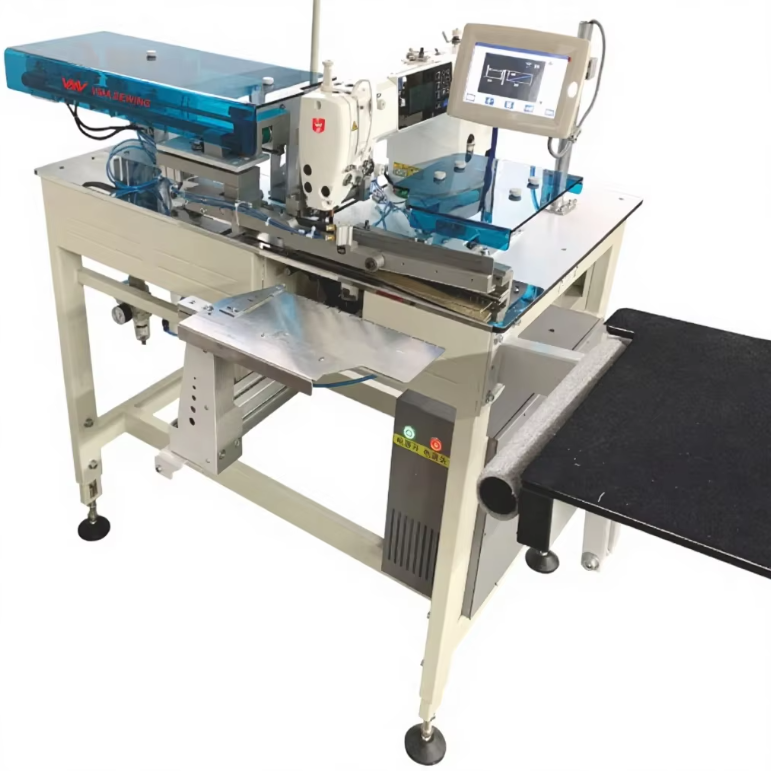
The VMA V-5015A-9000C Dart & Pleats Sewing Unit is designed for efficient dart and pleat sewing in garment production. It uses a JUKI 9000C sewing head and a step motor controlled feeding system to support stable fabric feeding and accurate sewing performance.
The machine is suitable for different fabrics and allows operators to program darts or pleats according to production requirements. With an adjustable frame height, SMC cylinder and Panasonic drive, the V-5015A-9000C provides a practical solution for garment factories requiring stable shaping quality and higher output.
Key Process Advantages
1. Step Motor Controlled Feeding
The step motor controlled feeding system helps ensure more accurate fabric movement during dart and pleat sewing. Stable feeding is important for keeping the dart or pleat shape consistent.
2. Easy Programmable Darts or Pleats
Operators can program different dart or pleat patterns according to garment requirements. This improves flexibility for factories producing multiple styles or different garment sizes.
3. Suitable for Different Fabrics
The V-5015A-9000C can be used for different fabric types, making it suitable for trousers, shirts, suits, skirts, uniforms and fashion garments.
4. JUKI 9000C Sewing Head
The machine is equipped with a JUKI 9000C head, supporting stable sewing performance and reliable stitch quality during continuous production.
5. Adjustable Frame Height
The adjustable frame height helps operators work more comfortably and adapt the machine to different production conditions.
6. Efficient Production Output
The machine can reach approximately 625–750 darts or pleats per hour, depending on fabric type, sewing length, pleat structure and production setup.
Dart and Pleats Sewing Process
Step 1: Prepare the Fabric Piece
The operator prepares the garment part that requires dart or pleat sewing. The fabric should be placed flat and aligned according to the sewing requirement.
Step 2: Set the Dart or Pleat Program
The required dart or pleat sewing pattern is selected or programmed on the machine. Parameters can be adjusted according to garment style and production needs.
Step 3: Feed and Clamp the Fabric
The fabric is positioned and fed through the machine. The feeding system helps maintain stable fabric movement during sewing.
Step 4: Complete Dart or Pleat Sewing
The machine completes the sewing process according to the programmed path, helping ensure consistent stitch quality and shape.
Step 5: Check Finished Shape
After sewing, the operator checks the dart or pleat length, stitch quality, symmetry and finished garment shaping effect.
Suitable Applications
The V-5015A-9000C Dart & Pleats Sewing Unit is suitable for:
- Trouser dart sewing
- Suit dart sewing
- Shirt dart sewing
- Skirt pleat sewing
- Uniform shaping process
- Women’s wear dart and pleat sewing
- Casualwear shaping seams
- Garment parts requiring stable fabric shaping
This machine is especially useful for factories producing garments where fit, symmetry and shaping quality are important.
Benefits for Garment Factories
Better Shaping Consistency
Programmable sewing and controlled feeding help ensure consistent dart and pleat shape across batch production.
Higher Production Efficiency
With an output of approximately 625–750 darts or pleats per hour, the machine helps improve production speed compared with manual sewing.
Reduced Dependence on Skilled Operators
The machine standardizes feeding and sewing actions, helping reduce reliance on highly skilled manual operators.
Flexible Style Changeover
Programmable dart and pleat settings make it easier to handle different garment styles and production requirements.
Stable Sewing Quality
The JUKI 9000C head, step motor feeding, SMC cylinder and Panasonic drive support stable sewing performance during production.
FAQ
What is the V-5015A-9000C used for?
The V-5015A-9000C is used for dart and pleat sewing in garment production, especially for trousers, shirts, suits, skirts, uniforms and women’s wear.
What is a dart sewing process?
Dart sewing is a garment shaping process used to create three-dimensional fit by sewing tapered seams on fabric parts.
What is a pleat sewing process?
Pleat sewing is used to fold and stitch fabric to create structured garment details, shape or decorative effects.
Can the machine sew different fabrics?
Yes. The V-5015A-9000C is suitable for different fabrics and can be adjusted according to production requirements.
Is the dart or pleat pattern programmable?
Yes. The machine supports easy programming for darts or pleats, making it suitable for different garment styles.
What is the production capacity?
The production capacity is approximately 625–750 darts or pleats per hour, depending on fabric type, sewing length and production setup.
Why use a dart and pleats sewing unit instead of manual sewing?
A dart and pleats sewing unit improves sewing consistency, reduces manual skill dependence, increases output and helps maintain stable garment shaping quality.
Contact VMA
If you are looking for a dart and pleats sewing unit for trousers, shirts, suits, skirts or garment shaping production, contact VMA to get machine videos, technical specifications and process recommendations.
//www.vmasewing.com/en/contact.html
TAIZHOU VMA SEWING MACHINE CO., LTD
Sewing Automation Solution Expert